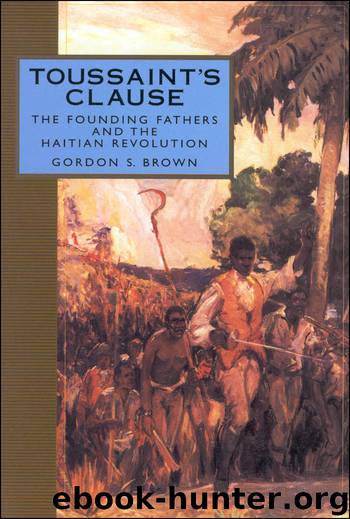
Toussaint's Clause: The Founding Fathers and the Haitian Revolution by Gordon S. Brown
Author:Gordon S. Brown [Brown, Gordon S.]
Language: eng
Format: epub
Tags: History, General, Biography & Autobiography, United States, Historical, Political Science, 19th Century, Haiti, Caribbean & West Indies, International Relations, Revolutionary Period (1775-1800), Revolutionary, United States - Foreign Relations - 1789-1809, Haiti - History - Revolution; 1791-1804, Diplomacy, United States - Foreign Relations - Haiti, Haiti - Foreign Relations - United States, Toussaint Louverture
ISBN: 9781578067114
Google: kbI01p9l3U8C
Amazon: 1578067111
Barnesnoble: 1578067111
Publisher: Univ. Press of Mississippi
Published: 2005-02-01T06:00:00+00:00
JEFFERSON EQUIVOCATES
We are all republicans, we are all federalists,” Jefferson said in his inaugural message to Congress. It was, to be sure, a nice rhetorical flourish, but it was also a true sentiment. The new president hoped that the defeat of the arch-Federalists meant a permanent political eclipse of their views, ones that he considered to be profoundly antirepublican, even monarchical. Moreover, the margin of his victory had been very close (as well as made possible largely through the split between the Adams and Hamilton camps), and consequently he needed to conciliate the Federalist middle-of the-roaders. It was, indeed, a good time for fence-mending, after the vituperation and animosity of the past few years.
The Republican victory, narrow as it was, nonetheless marked an important political turning point. The country itself was changing. Republican victory in the 1801 congressional elections would confirm it: the political center of gravity in America was shifting westward, away from the coastal cities, toward the small farmers of the Piedmont, and even to the new states and territories across the mountains in the “western waters.” And the new voters were largely Republican; they wanted a small government, low taxes, and cheap land. Even the seaboard states were changing politically. Not only New York had gone Republican in the presidential elections; so had South Carolina, where Charles Pinckney, the only Republican in that otherwise staunchly Federalist family, had led the upcountry voters against the old Charleston establishment. It was not yet fully evident, but the Federalists’ day was over, and with it the political dominance of the merchant and financial interests of the seaboard cities.
Download
This site does not store any files on its server. We only index and link to content provided by other sites. Please contact the content providers to delete copyright contents if any and email us, we'll remove relevant links or contents immediately.
| Africa | Americas |
| Arctic & Antarctica | Asia |
| Australia & Oceania | Europe |
| Middle East | Russia |
| United States | World |
| Ancient Civilizations | Military |
| Historical Study & Educational Resources |
Cat's cradle by Kurt Vonnegut(15355)
Pimp by Iceberg Slim(14506)
4 3 2 1: A Novel by Paul Auster(12392)
Underground: A Human History of the Worlds Beneath Our Feet by Will Hunt(12097)
The Radium Girls by Kate Moore(12028)
Wiseguy by Nicholas Pileggi(5784)
The Fire Next Time by James Baldwin(5444)
Perfect Rhythm by Jae(5403)
American History Stories, Volume III (Yesterday's Classics) by Pratt Mara L(5307)
Paper Towns by Green John(5191)
Pale Blue Dot by Carl Sagan(5008)
A Higher Loyalty: Truth, Lies, and Leadership by James Comey(4964)
The Mayflower and the Pilgrims' New World by Nathaniel Philbrick(4503)
The Doomsday Machine by Daniel Ellsberg(4490)
Killers of the Flower Moon: The Osage Murders and the Birth of the FBI by David Grann(4447)
The Sympathizer by Viet Thanh Nguyen(4390)
Too Much and Not the Mood by Durga Chew-Bose(4348)
The Borden Murders by Sarah Miller(4325)
Sticky Fingers by Joe Hagan(4198)
